Website stock and shelf stock disagree
Somebody buys the last one online an hour after it went out of the door in a carrier bag. Now you are emailing an apology.
Foundation Who we build for Shops & retail
You know what sold today. You do not know what has been hanging on the rail for ninety days quietly eating your cash. We build the website, the till and the stock system that tells you — on a phone, on the shop floor.
The bit that hurts
Independent retail has one problem no spreadsheet solves: knowing which stock is working and which is slowly turning into a loss.
Somebody buys the last one online an hour after it went out of the door in a carrier bag. Now you are emailing an apology.
Turnover looks fine. Meanwhile a third of the shop has not moved since February and that is where the cash went.
Counting by hand, twice a year, and being wrong anyway. Nobody does it often enough to be useful.
The takings are in one place, the stock in another and the accounts in a third, and reconciling them is somebody's Monday.
An example site
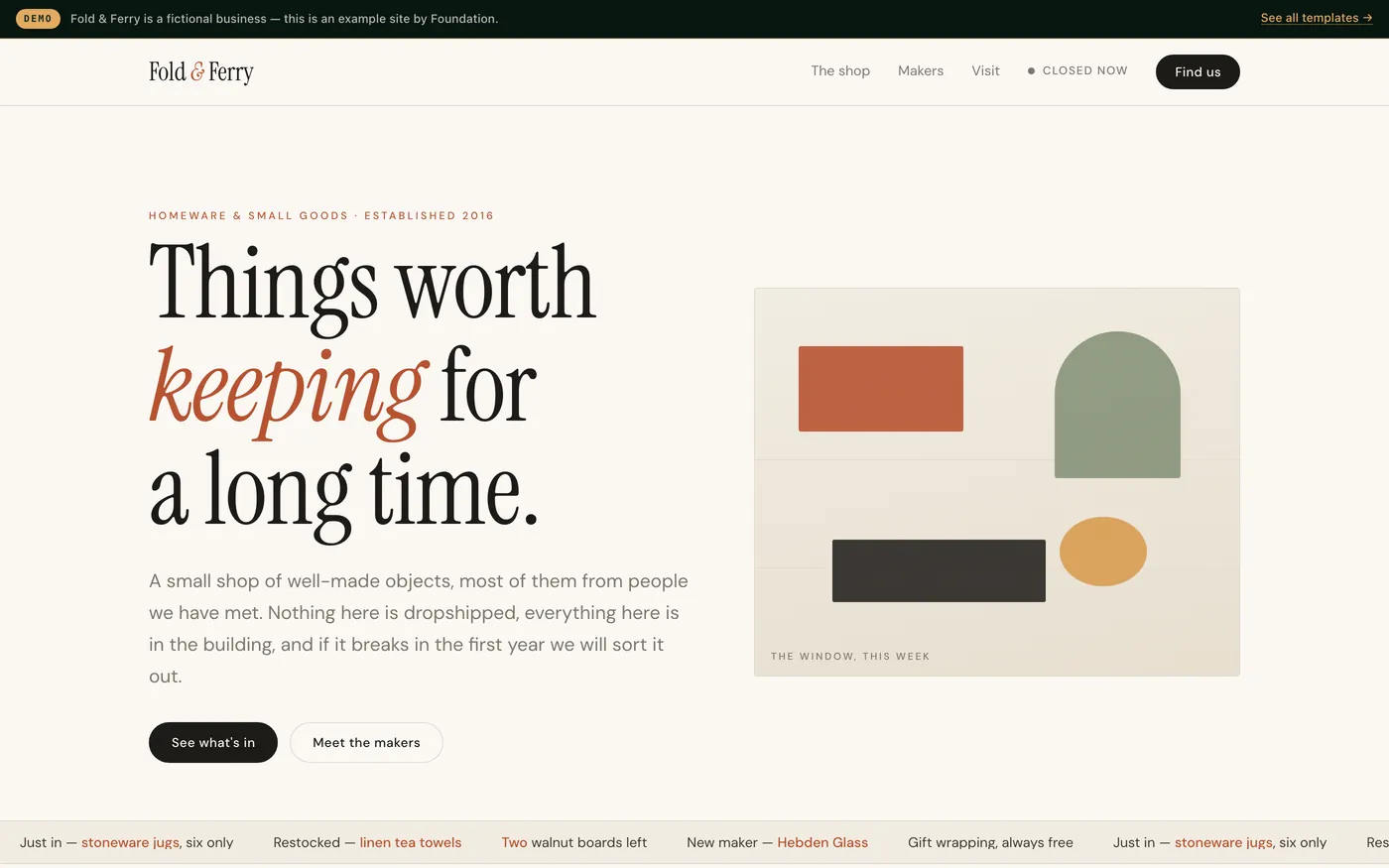
If your site says three left, three should be left. This example runs the shop window and the shelf from the same numbers, and shows an open-right-now badge that comes off the real clock.
Fold & Ferry is a fictional shop. This is a working example site — try the colourways.
What we build for you
Everything below is software we have already built and that is in daily use in a real shop. It runs in a phone browser — there is no hardware to buy.
Your own labels, manufacturer barcodes or QR tags, read through the phone camera on the shop floor. No scanner gun, no dock.
A full till: baskets, discounts, returns, card and cash split out, and an end-of-day count that tells you if the tin is short.
Fresh, slowing, stale, dead. One screen showing how much money is sitting in stock that has not moved in ninety days, and which pieces they are.
The till, the website and the stockroom read the same figure. Sell the last one at the counter and it comes off the site immediately.
Market stalls, church halls and basements. Sales and intake queue up locally and sync the moment the signal returns.
What sold, what made money, what is worth reordering and what should be marked down. Not a data export you never open.
The system behind it
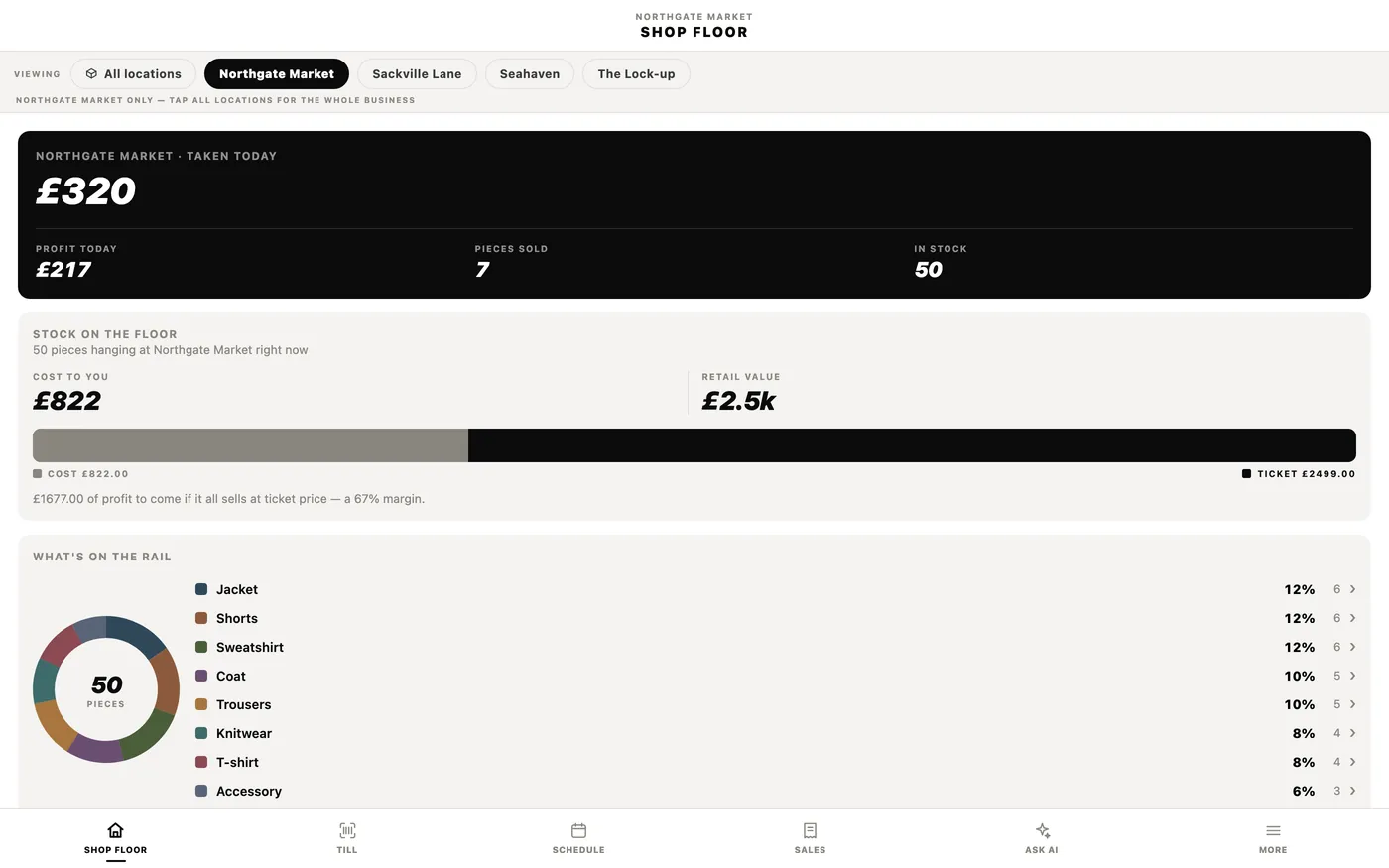
This is a stock and till system in daily use across three shops and a store room. The shop's name, staff and every garment shown have been changed for this page — the software is exactly what they use.
Real system, invented business. Every name and figure below is made up.
How it goes
Shops usually start with the till and the stock, because that is where the money is leaking, and add the website once the stock numbers are trustworthy.
What you sell, how it is priced, whether every item is one of a kind, and what you are guessing at today.
Real link, real till, on your phone.
Existing lines imported or scanned in, with labels printed if you need them.
The website generated from the same stock, so the two can never disagree.
Sound like your week?
Tell us what eats it — you'll have a fixed price back today, usually within the hour.
Where we work
A high-street shop lives on people who are already nearby. Every site is built to be found for your town, your street and the things you actually stock.
On your doorstep
We're in Windlesham, and we'll come to you — a coffee and a whiteboard beats a video call. Anywhere within twenty miles, plus the whole of London.
And everywhere else
We build for retailers across the UK and the US. The till runs in a browser, so where the shop is makes no difference to us.
What it costs
A shop website starts at £250. The till, stock and reporting are quoted free, priced on what they do.
Or £220 up front and £19 a month — we host it, back it up nightly and keep the certificate valid. Compare both →
Get my priceNothing gets built until you've seen the price, and the price doesn't move afterwards. If it takes us longer than we thought, that's our problem, not your invoice.
Quick answers
The website starts at £250, or £220 up front plus £19 a month hosted and maintained. The till and stock system is quoted free and priced on what it does.
No. It runs in the browser on the phone you already own, and the phone camera is the scanner. If you want a receipt printer or a label printer we will tell you which ones work.
That is the case we built it for. Each piece gets its own label and its own record, so a vintage or second-hand shop is handled properly rather than forced into a product-and-variant model.
Yes. Sales and stock intake queue locally and sync when the signal comes back, so a bad afternoon of reception does not cost you the day's takings.
That is the report most shops say they wanted. Stock is banded by age — fresh, slowing, stale and dead — with the money sitting in each band shown in pounds.
Yes, and they should. Sell the last one at the counter and it comes off the website there and then.
Answered?
Two fields and a tap. You'll hear back from a real person, usually today.
Also built for
Different words on the front, the same machinery behind it. See every trade we build for →